
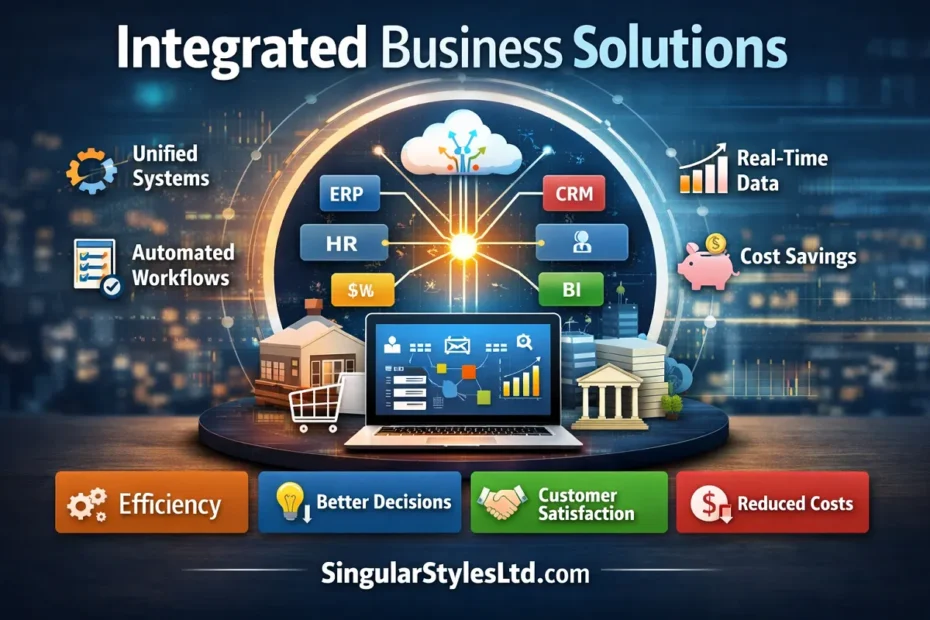
In today’s digital business environment, companies rely on multiple tools and software systems to manage operations such as sales, finance, customer service, inventory, and human resources. However, when these systems operate separately, businesses often face problems like data duplication, communication gaps between departments, and inefficient workflows. This is where integrated business solutions become essential. Organizations increasingly adopt integrated systems to connect their various tools, allowing information to flow smoothly across departments and improving overall operational efficiency. Understanding the integrated business solutions meaning helps businesses recognize how combining different technologies into one unified platform can streamline processes, improve decision-making, and enhance productivity. This article explains the definition of integrated business solutions, how they work, their key components, real-world examples, benefits, and why companies are increasingly adopting integrated systems.
What Are Integrated Business Solutions?
Integrated business solutions refer to the combination of multiple business applications, systems, and processes into a single unified platform that allows different departments within an organization to share data, automate workflows, and operate more efficiently.
Instead of using separate software for finance, customer management, inventory, and human resources, integrated business solutions connect these systems so they can work together seamlessly.
In simple terms, integrated business solutions create a centralized system where business data flows smoothly across all departments, improving coordination and reducing manual work.
Simple Explanation
Imagine a company using separate software for:
-
Sales tracking
-
Accounting
-
Inventory management
-
Customer service
-
Human resources
If these systems are not connected, employees must manually transfer data between them, which can cause delays and errors.
With integrated business solutions, these systems communicate automatically. For example, when a sale occurs, the system can automatically update inventory, generate an invoice, and record the transaction in the accounting system.
This integration saves time, reduces errors, and helps the business operate more efficiently.
Key Components of Integrated Business Solutions
Integrated business solutions typically combine several important business management systems. These components work together to provide a complete view of business operations.
ERP Systems
Enterprise Resource Planning (ERP) systems are one of the most common components of integrated business solutions. ERP platforms manage core business processes such as:
-
Finance
-
Inventory
-
Supply chain
-
Procurement
-
Production
ERP systems act as the central hub where data from different departments is stored and processed.
CRM Systems
Customer Relationship Management (CRM) systems help businesses manage customer interactions and sales processes.
CRM systems typically handle:
-
Customer information
-
Sales tracking
-
Marketing campaigns
-
Customer support
When integrated with other systems, CRM software allows sales teams to access inventory, billing data, and order history instantly.
Accounting Software
Accounting systems manage financial operations such as:
-
Invoicing
-
Expense tracking
-
Payroll
-
Financial reporting
-
Tax calculations
Integration ensures that financial data is automatically updated when transactions occur in other systems.
HR Management Systems
Human Resource Management Systems (HRMS) manage employee-related processes, including:
-
Payroll
-
Employee records
-
Recruitment
-
Performance management
-
Attendance tracking
Integration allows HR systems to connect with payroll, accounting, and project management tools.
Business Intelligence Tools
Business intelligence (BI) tools analyze company data and generate reports that help managers make informed decisions.
These tools can provide:
-
Performance dashboards
-
Sales analytics
-
Financial insights
-
Market trends
When connected to integrated systems, BI tools provide real-time business insights.
How Integrated Business Solutions Work
Integrated business solutions operate by connecting multiple systems through shared databases, APIs, or centralized platforms. This connection allows different departments to access and update information in real time.
Centralized Data System
One of the main features of integrated business solutions is a centralized data repository. All departments access the same database, ensuring consistent and accurate information across the organization.
For example:
-
Sales teams enter customer orders
-
Inventory systems update stock levels
-
Accounting records the revenue automatically
Because all systems share the same data, businesses avoid duplicate entries and data inconsistencies.
Automated Workflows
Integrated systems automate business processes that normally require manual input.
For example, when a customer orders something:
-
The sales system records the order.
-
Inventory levels are automatically adjusted.
-
The finance system generates an invoice.
-
Shipping receives order details for delivery.
This automation saves time and lowers the mistakes made by people.
Real-Time Information Sharing
Integrated business solutions allow departments to access real-time data. This improves communication and collaboration across teams.
For example:
-
Customer service teams can view order status instantly.
-
Sales teams can check product availability before making commitments to customers.
-
Managers can monitor performance through live dashboards.
Benefits of Integrated Business Solutions
Organizations adopt integrated business solutions because they offer several important advantages.
Improved Operational Efficiency
Integrated systems eliminate repetitive tasks such as manually transferring data between different software platforms. Automation improves workflow efficiency and reduces administrative workload.
Employees can focus more on strategic tasks rather than routine data entry.
Better Decision-Making
With integrated systems, managers have access to real-time business data. This allows them to analyze performance quickly and make informed decisions.
Accurate data helps businesses identify trends, monitor financial performance, and improve planning.
Enhanced Customer Experience
When customer data is integrated across departments, businesses can deliver better service.
For example:
-
Sales teams know the customer’s purchase history.
-
Support teams can access previous interactions.
-
Marketing teams can personalize offers.
This leads to improved customer satisfaction and loyalty.
Reduced Costs
Automation and streamlined workflows help businesses reduce operational costs. Companies spend less time on manual processes and avoid costly errors caused by data inconsistencies.
Integrated systems also reduce the need for maintaining multiple disconnected software systems.
Increased Productivity
Employees can work more efficiently when they have access to unified systems and accurate data.
Integrated business solutions reduce the time spent switching between multiple tools and searching for information.
Examples of Integrated Business Solutions
Many organizations use integrated platforms to manage their operations effectively.
ERP Platforms
ERP systems are widely used as integrated business solutions because they combine multiple business processes into one platform.
Common ERP platforms include:
-
SAP
-
Oracle NetSuite
-
Microsoft Dynamics
-
Odoo
These systems connect finance, supply chain, production, and inventory management.
CRM Integration
Businesses often integrate CRM systems with marketing, sales, and customer support tools.
For example:
-
Customer information collected by marketing campaigns is automatically available to sales teams.
-
Support teams can see complete customer interaction histories.
This integration improves customer relationship management.
E-commerce Integration
Online businesses frequently integrate their e-commerce platforms with other systems.
For example:
-
Inventory management
-
Payment processing
-
Shipping and logistics
When a customer places an order, the system automatically updates inventory and generates shipping instructions.
Integrated Business Solutions vs Traditional Systems
Traditional business systems often operate independently, which can create inefficiencies.
| Feature | Traditional Systems | Integrated Business Solutions |
|---|---|---|
| Data Storage | Separate databases | Centralized database |
| Workflow | Manual processes | Automated workflows |
| Reporting | Delayed reports | Real-time reporting |
| Collaboration | Limited communication | Seamless collaboration |
| Efficiency | Lower productivity | Higher productivity |
Integrated solutions provide a more connected and efficient business environment.
Industries That Use Integrated Business Solutions
Integrated business solutions are widely used across many industries.
Manufacturing
Manufacturers use integrated systems to connect production planning, supply chain management, and inventory tracking.
Retail
Retail companies integrate sales systems, inventory management, and customer data to improve operations.
Healthcare
Healthcare organizations use integrated systems to manage patient records, billing, and appointment scheduling.
Finance
Financial institutions integrate customer data, risk management systems, and financial reporting tools.
Logistics
Logistics companies integrate transportation management, warehouse operations, and shipment tracking.
E-commerce
E-commerce businesses rely heavily on integration to connect online stores with payment systems, shipping providers, and inventory management.
Challenges of Implementing Integrated Business Solutions
Although integrated systems provide many benefits, implementing them can present challenges.
Implementation Costs
Setting up integrated systems can require significant investment in software, infrastructure, and consulting services.
System Migration Issues
Migrating data from older systems to new integrated platforms can be complex and time-consuming.
Employee Training
Employees may need training to use new integrated systems effectively.
Data Security Concerns
When systems are connected, organizations must ensure strong cybersecurity measures to protect sensitive data.
How to Choose the Right Integrated Business Solution
Choosing the right integrated solution depends on several factors.
Business Size
Small businesses may prefer cloud-based platforms, while large enterprises often require complex ERP systems.
Budget
Businesses should evaluate the total cost of implementation, including software licenses, training, and maintenance.
Scalability
The system should be able to grow with the business as operations expand.
Integration Capabilities
The solution should easily connect with existing software and tools used by the company.
Vendor Support
Reliable vendor support is essential for troubleshooting and system updates.
Future Trends in Integrated Business Solutions
Technology continues to evolve, and integrated business solutions are becoming more advanced.
AI-Powered Integration
Artificial intelligence is being used to automate business processes and improve decision-making through predictive analytics.
Cloud-Based Platforms
Cloud technology allows businesses to access integrated systems from anywhere while reducing infrastructure costs.
API-Driven Systems
Modern systems use APIs to connect applications quickly and efficiently.
Automation and Machine Learning
Automation tools and machine learning algorithms are helping businesses optimize workflows and improve operational efficiency.
Frequently Asked Questions
What is meant by integrated business solutions?
Integrated business solutions refer to systems that combine multiple business applications into one unified platform. This integration allows departments to share data, automate processes, and improve operational efficiency.
What are examples of integrated business systems?
Examples include ERP platforms, CRM systems integrated with marketing tools, and e-commerce platforms connected to inventory and accounting systems.
Why do companies use integrated business solutions?
Companies use integrated solutions to streamline operations, improve data accuracy, automate workflows, and enhance collaboration across departments.
What is the difference between ERP and integrated business solutions?
ERP is one type of integrated system that focuses on managing core business processes. Integrated business solutions may include ERP along with CRM, HR systems, and other tools connected together.
Are integrated business solutions good for small businesses?
Yes, many cloud-based integrated platforms are designed specifically for small and medium-sized businesses, making them affordable and scalable.
Conclusion
Integrated business solutions play an essential role in modern organizations by connecting various systems, departments, and processes into a unified platform. By integrating tools such as ERP, CRM, accounting, and HR systems, businesses can improve efficiency, automate workflows, and gain valuable insights through real-time data.
As companies continue to adopt digital technologies, integrated systems will become even more important for maintaining competitiveness and improving operational performance.
Understanding the integrated business solutions meaning helps organizations recognize how technology integration can transform business operations, reduce costs, and support long-term growth.